



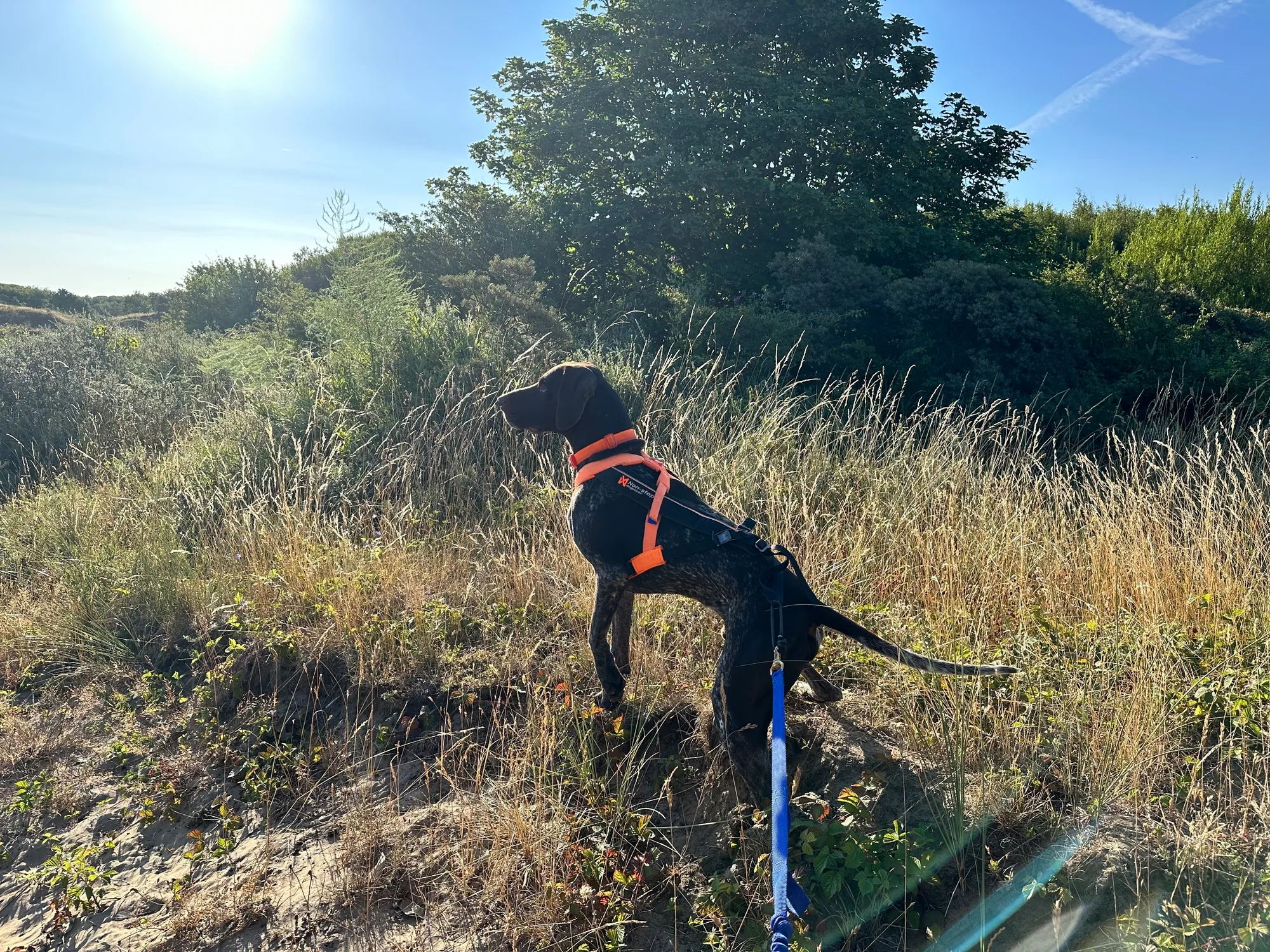
For a long time I was convinced that my two German Shorthaired Pointers needed up to two solid hours of exercise every day. Like many owners of high-drive working breeds, I had believed that more was always better. From the time they were young I took them out for long off-lead walks in the local sand dunes, beach and pinewoods. Our walks felt perfect: open space, soft ground, room to run at full stretch, explore and just enjoy being a dog. I worked hard on check-ins and recall, and for a while everything looked fine. The dogs came when called, stayed relatively close, and seemed to burn off energy in the best possible way.
Then, around the age of two, things started to unravel.
Scout became severely reactive. Milo began ignoring recalls and chasing deer. What had once felt like successful free exercise and enjoyable walks suddenly became a daily disaster that filled me with dread.
In the long process of realising the problem was getting worse and then trying to fix it, I watched thousands of YouTube videos, read many books, and completed the Victoria Stilwell dog trainer certification course. That education helped me understand exactly what had gone wrong and gave me a clear framework for how to put it right. But acquiring knowledge is one thing. The actual experience of fixing the problem through trial and error and seeing what finally worked on my own dogs taught me more about training high-drive dogs than any book or quick-fix reactivity video ever had.
Looking back, a little older and wiser, the mistakes were entirely mine.
How Good Intentions Created Bad Habits
Scout is an anxious, high-drive girl - I didn't know that when I chose her out of the litter of puppies almost five years ago. On those early off-lead walks she regularly met other off-lead dogs. When a new dog or group of dogs approached she would often roll over, show her belly, and freeze. I interpreted this as play or friendly submission. In reality she was probably terrified. Every time I stood back and “let them work it out,” I was teaching her two damaging lessons: the world can be scary, and your human will not step in to protect you. Over time the fear hardened into a strategy. First she began snapping when dogs came too close, trying to create space. Then she started running up to other dogs pre-emptively to deliver that same warning snap. Reactivity that had started as self-defence had become proactive and hard to manage.
While I was absorbed in Scout’s growing problems, Milo received less attention. He is a classic GSP—curious, driven, and deeply interested in wildlife. On the long off-lead walks he gradually learned that the dunes were his to explore. I became little more than the person who transported him there and collected him afterwards. His previously excellent recall slowly eroded. Places that once felt safe became off-limits because the deer and pheasant temptation was simply too high for a dog who no longer saw me as relevant.
The common thread became clear: unstructured freedom, especially when paired with insufficient support and lack of focus, had created two different but equally serious problems. Quantity of exercise had come at the expense of quality of relationship.
Taking the Freedom Away
I decided on a deliberate reset. For six weeks the dogs lost their free-running privileges. No more off-lead time in the dunes. Instead I took them out individually, morning and evening, for structured thirty-minute sessions. The total time I spent walking stayed roughly the same, but almost everything else changed.
Each outing followed the same pattern. We began in the garden with a short training or play session. This gave them a chance to toilet, switch on and tune into me. Next came place work and threshold manners in the hall so that leaving the house was calm rather than chaotic. Once we were outside we did a five-minute lead walk at heel followed by twenty minutes on harness and long line in the dunes. The long line gave them limited room to explore and sniff, but no free running.
Scout’s reactivity work was carefully layered. I managed distance and used distraction so she could practise walking past other dogs at a range where she wouldn't lose her mind. At first the distance was around 30 metres where she could watch other dogs calmly and respond to my cues. Over the weeks we gradually reduced that distance. The goal was never to force her through flooding; it was to rebuild her confidence that I would notice a problem and handle it before she felt she had to.
Milo received a different prescription. He started with a few minutes on a long lead to sniff and explore at the start of the walk to settle in. Then a few minutes off-lead with recall practice and games to keep him focused on me and rebuild a solid recall response, then back on the lead to calm down again, and repeat. The off-lead free time was slowly increased while the recall practice and games stayed at around 5 minutes, but even at the end of the six weeks it rarely exceeded twenty minutes. The message was consistent: freedom is a privilege that depends on staying connected to me.
Why It Worked
The difference was striking. Because the sessions were shorter, more frequent, and structured, both dogs finished them more mentally satisfied than they had after the old hour-plus free runs. Scout’s reactivity improved. She still notices other dogs, and sometimes she still flips out if a dog comes too close, but she looks to me far more often and recovers more quickly. Milo’s recall, which had slipped badly, began climbing back toward reliability. Wildlife-heavy areas that had become impossible were gradually reintroduced under controlled conditions.
The reduced free-running time did not leave them under-exercised or frustrated which would thwart my carefully thought through plan. The secret sauce is giving them proper outlets for their energy and drive, but always under control. We use canicross for the running outlet (trail running on a line attached to me) and gundog skills training in a secure field for the hunting outlet. The weekly schedule is simple: we aim for two to three days of canicross, two to three days of gundog work, and one rest day. This combination prevents the frustration that can build when free time is restricted, while still delivering the intense physical and mental work that GSPs genuinely need. What disappeared was only the long, unstructured off-lead time that had been teaching them the wrong lessons about independence and safety.
The Real Lesson
The biggest shift was not in the dogs’ exercise levels. It was in the relationship. When walks became times of deliberate engagement rather than free exploration, with clear, consistent rules, the dogs started treating me as relevant again. I stopped being the taxi and became much more interesting and the source of good things. That single change solved problems I had been struggling with for months.
I still believe high-drive dogs need substantial exercise. What I no longer believe is that one to two hours of free running is automatically the answer. For many young or adolescent working dogs, especially those with any tendency toward anxiety or independence, unstructured freedom can quietly erode the very skills we need most—reliable recall, calm social behaviour, and the habit of checking in with their human.
If I could go back, I would still take my GSPs to the dunes. I would simply keep them on a long line far longer, practise more engagement games, and treat every encounter with other dogs as a training opportunity rather than a social free-for-all. The six-week reset was corrective, not ideal. Prevention would have been kinder and easier.
These days our walks look different. They are shorter on free time and far more intentional. I still believe dogs need freedom to explore, run and just be dogs. I now know that 20 minutes twice a day gives them enough, the dogs are happier for it, and so am I. Sometimes the most useful thing you can do for a high-drive dog is not to give them more freedom, but to give them clearer boundaries, stronger reasons to stay connected with you, and structured outlets that satisfy their drive without undoing your training.